
|

|
|
|
 German
 German tanks used in the TV series Combat! were actually contemporary American tanks painted with German symbols.
The stock war footage used in the show often features Panzers. Germany developed four versions of the Panzer.
Once Hitler came to power, there was a flurry of tank development in Germany. The German Army first used the Panzer I in 1933. The Panzer II was released in 1934. The original 1933 version weighed 7.2 tons, and had a 20 mm cannon and a machine gun in the turret. After many modifications, the Panzer II went into mass production in 1937. By that time the tank weighed 9.5 tons.
Both the Panzer III and Panzer IV were released in 1937. The IV became the backbone of Germany's Panzer force and the power behind the Blitzkrieg. The Panzer IV was manufactured by Krupp. The armor protection ranged from 8 mm to 30 mm in thickness.
In battle conditions in Poland, 1939, the inadequate armor plating for the Panzer I proved fatal. The reliable models II and III were better protected, but outgunned. The Panzer IV ruled the battlefield with its mix of speed, agility, firepower, and reliability. Germany produced over 9,000 of these tanks, more than any other WWII model.
The Panzer IV continued to do well as Hitler over-ran Europe and Africa. But the tank met serious resistance during the invasion of Russia in 1942. This lead Germany to develop the Panther tank. Its 75mm gun could penetrate Soviet tanks. Other features included sloped armour to deflect shot, torsion-bar suspension, and interleaved road wheels. The armor was 80mm thick.
Another model released in 1942 was the Tiger Tank, produced by Henschel. It had armor between 25 mm and 100 mm in thickness. The Tiger tended to overheat in battle and suffered problems with the suspension. It was replaced by the Tiger II, also known as King Tiger.
| Model | Crew | Engine | Weight | Max Speed | Weapons |
|---|---|---|---|---|---|
| Panzer I | 3 | 130 hp | 20 mm cannon and machine gun | ||
| Panzer II | 3 | 140 hp | 7.2 – 9.5 tons | 25 mph | 20 mm cannon and machine gun |
| Panzer III | 5 | 230 hp | 15 tons | 37 mm cannon and machine gun | |
| Panzer IV | 5 | 230 hp | 17.3 tons | 18 mph | short 75 mm gun and 2 machine guns |
| Panther | 650 hp | 28 mph | 75 mm gun | ||
| Tiger | 700 hp | 55 tons | 23 mph | 88 mm gun | |
| Tiger II or King Tiger |
70 tons | 128 mm gun |
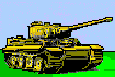 PzKpfw VI - I Tiger |
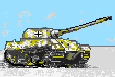 PzKpfw VI - II King Tiger |
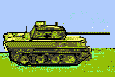 PzKpfw V Panther |
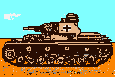 PzKpfw IV |
PzKpfw III |
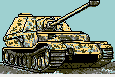 Jagdpanzer JagdpanzerTiger-Elefant |
Flag and tank icons created by Mario Paesani.



Developed during the 1930s in contravention to the Treaty of Versailles, German tanks,
along with the panzer units that operated them, were counted among the most feared
conventional weapons of World War II. The story of German tank evolution, firsthand
accounts of savage tank battles, tank comparisons, explanations of roles, and detailed
armor and armament specifications combine with modern and rare period color photography to
reveal the stories behind Germany's light armored support vehicles, light and medium
Panzer tanks, and the behemoth Tiger tanks. At just 96 pages, this small book packs an
incredible amount of information into an affordable overview. Plus spectacular color
photos throughout! Incredible eye candy for the re-enactor, modeler, or general Combat!
fan.


Book
Description 1,000 b/w illustrations! A complete illustrated directory is finally available
that shows and describes nearly 300 types of German battle tanks, armored cars,
self-propelled guns, and semi-tracked vehicles manufactured and put into service from 1933
to 1945. Only recently have the records of the manufacturers been made public, so never
before could you know just how many of each model were available, along with accurate
dates of their production and mobilization. Historic photos identify features of each
vehicle type, including uncommon variants. Captions are packed with accurate details on
designations given by the German Army General Staff: alternative designations,
manufacturing and development history, chassis numbers, engine capacity, fuel, coolants,
gearbox performance, speed and range, armament, armor material and thickness, and service
record. Trim size: 8 3/4 x 11.
More German
Weapons:


 American Flag Jewelry
